(Accessibility: read this on white background)
This essay is part of The Future of AI, a long-form essay series cutting through the AI hype and mapping out from first principles the tectonic shifts affecting labor, business models, and product interfaces.
INTRODUCTION
It is not lost on us that intelligence can sometimes be an ephemeral term that changes definitions depending on whom you ask. Nonetheless, what the tech industry is attempting to do is synthesize human intelligence and enable a machine to think, process and act like humans. It’s another debate whether this is a good thing, but in our journey to understand the impact of AI – the threats and the opportunities – on us humans, we must first ask what AI can truly do and how far it can go.
It begins with understanding the parallels between human cognition and artificial intelligence, because this overlap is where most of the threats and myths and facts and opportunities exist. The truth is, the answer is not entirely what the tech industry is telling you. They are selling you. And no matter where else you’re getting your information from, in many cases, they fall short of digging deeper, asking the right questions and drawing the right conclusions. And I’m saying this as a technologist myself. We need answers from first principles, and we’ll be building them together. Let’s get into it.
The Lay of the AI Land
You might have already heard of AI as being “prediction systems” or “next word/token predictors”. You might have also heard that AI needs a lot of data and they are “models”. That is a great start, but we want to scratch deeper than the surface.
AI isn’t some nebulous new technology. The most successful companies today grew on the back of AI. The products recommended to you on Amazon, the shows on Netflix, the search results and ads you see on Google, the drivers assigned to you on Uber, all use some form of AI. Machine Learning is the more accurate term for this, but ML is a subset of AI, like so many other variations of AI applications.
An Intuition for AI
A great way to build intuition for AI is to understand that AI is just another type of code written to make machines do our bidding – specifically, to answer questions or compute a solution, usually at scale, on the fly and of advanced complexity. In traditional code, we tell the computer exactly what it has to do for any given user input. Developers define the rules and algorithms that govern how a computer responds to inputs, and the software program looks up those exact instructions at run time to compute a predictable, deterministic output.
With AI however, AI figures the output on its own in real-time depending on the input data it sees – there’s no pre-determined instruction in its code prescribing how to compute the output for the input it encounters. Nobody writes the explicit steps for how Claude or GPT should respond; it discovers its own pathways during training.
We’ll understand how this is possible shortly, but in essence, when we prompt AI, it runs a calculation in real-time to determine the output. The type of calculation to run is defined by a “model”. The models and methods used vary by the problem and intended use case. They include regression, decision trees, random forests, clustering algorithms such as K-means, time-series models, graph analysis and large language models (LLMs) such as GPTs. For example, when processing structured numerical data, it is straightforward to apply regression or decision tree models. When dealing with text, we typically opt for Large Language Models (LLMs) like GPT architectures. When processing complex visual data like video, we deploy specialized deep learning networks, such as Convolutional Neural Networks (CNNs) or Video Transformers.
In all of these, the “calculations” performed are statistical (and for LLMs, stochastic) in nature, meaning the output is determined by a distribution or probability score. The higher the probability that something should be the output, based on patterns found in its training data, the more likely it is to be generated at run-time.
When you hook up an AI model to a product, the user’s inputs pass through the model, which uses that data to run a calculation using the internal pathways – or weights – it developed during training. Those pathways were shaped by optimizing for specific goals across massive amounts of similar data, allowing the model to apply those learned pathways to compute a final output on the fly.
And this is where you begin to understand why AI has “intelligence” in its name. We give it a problem and a goal, and it figures out the solution using its own “intelligence”. Just like humans (or so it seems). And just like humans, AI develops intelligence by learning; learning from its own past experiences, learning from others’ experiences, learning from facts and information presented to it and learning from feedback.
How AI Learns
A newborn AI doesn’t have past experiences or feedback, and so we must train it with “others’ experiences”. This is where the need for massive amounts of data comes in. We collect massive amounts of historic data representing the data AI may see in the future and, for each of those data points, we may also collect what the output was or should be. The AI model is then fed this data to “learn” from. In some cases, we may just let the AI learn patterns from the input data alone (unsupervised learning). Either way, it learns patterns and develops its own internal computational maps based on the data it is trained on, i.e. for inputs like these, use this path to choose the output. That is how AI figures out outputs on its own without being given explicit rules.
These computational maps are sometimes hard to understand or explain, and that’s why complex AI models are sometimes referred to as black boxes (and why explainability is a huge challenge in AI). How the model (constraints and parameters) allows AI to arrive at weights and build its own computation path is beyond the scope of this essay, but simply put, it uses probabilities, error adjustments, statistical methods, and other mathematical approaches to arrive at this map.
AI Is Always a Prediction
When it is put out into the real world, and AI receives a user input, it falls back on its training “computational pathways” to determine an output. It draws parallels between the user input to one in its training data set, and based on the output it had learned to be the most probable for that input, it calculates a similar output for the real-world user. This output could be right or wrong. The whole process is akin to making predictions, because there is no written rule that says when “this is the input data, this should be the output data”. Instead, it is always an educated guess based on available data, patterns and probabilities, which is why it is never 100% guaranteed to get it right (and why a spam filter might occasionally mark real spam as “Not Spam”.)
A team of data scientists is always pushing to increase the accuracy (correctness) of this “prediction”. They use various techniques to do so, and one obvious way is using more data. The more times an AI model sees a specific input-output combination, the more likely it is to learn that “for a given input, this should be the output” (though sometimes this relationship may not be learned reliably). That’s how many AI models can reach a viable level of accuracy and usefulness, to the point where they start being seen as actually intelligent.
But what continues to make it a probabilistic system, no matter how high an accuracy you reach, is that AI continues to apply previously learned patterns and computation parameters to solving future encounters with never-before-seen input data. This means that when real-world inputs differ substantially from the patterns represented in its training data – data it has never “learnt” from – the model may be less reliable. Even familiar-looking inputs exploiting gaps in a model’s learning can produce errors. The takeaway here is that because we haven’t given AI a prescribed instruction manual, the chance of it outputting an undesired answer is always non-zero. This is not a deal breaker, but something to be aware of.
AI comes baked in with the expectation that it will make mistakes (like humans) and learn from them especially when presented with new data. In fact, this is why data drift and addressing it within AI products is a critical component of product planning and strategy. So also is the amount of data that a model can reliably ingest and compute at any given time (referred to as context window in LLMs). These are simply mathematical limitations of AI that are born of the physical realities of the medium in which it exists.
Which points us to something important– if you earlier believed that AI will eventually become perfect at infinity, or will transform into “Superintelligence” – more intelligence than all humans combined – in reality, it isn’t possible. While conceptually sound, they are practically brittle. There will always be new data, and new humans with new intelligence. In a real messy world where rules change and new knowledge is continuously being discovered, an AI by itself cannot learn or invent knowledge about this without a human training it. Which means the concept of AI knowing everything, being able to solve everything and getting predictions correct 100% of the time, every time, is true as far as AI hits the real world, and until which time an all-knowing AI exists only inside Schrödinger’s box.
AI in Action
To quickly understand everything we spoke about so far, let’s see this in action.
When an e-commerce store “recommends” that you purchase a scarf, it is applying patterns from its past training. Its training input was a past customer with your approximate characteristics (gender, age, location, income category, past purchase history) who had purchased a scarf (the training output). Now, when it sees you shopping with a similar profile and browsing behavior (the new input), it predicts that the right output (recommendation) should be a scarf.
When you type “The quick brown fox” into an LLM, it has seen enough input-output combinations during its training that it pools towards a collective weight that says “jumps over the lazy dog” should be the right output, which is what it displays to you.

When an AI generates an image, it uses a process called diffusion. The AI starts with a canvas of random digital noise (which looks like television static). It then uses complex calculus and statistical probability to predict, step by step over iterative denoising actions, how to turn that static into a clear image that matches your prompt. Those pixel predictions come from learning input-output combinations from vast amounts of images, that were labelled with your kind of prompt, it saw during training.
When GenAI creates a video, it treats the video like a data science problem. The AI tracks thousands of mathematical coordinates across individual frames. It then calculates the statistical probability of how light, geometry, and motion should shift from one millisecond to the next based on billions of video clips it has analyzed.
If there’s anything you should take away from this section, it is this – AI always needs to be “trained” first, AI is bound by the limits of that training data, and AI always works with inputs and outputs, applying logical, mathematical, stochastic and binary (yes or no) instruments to complete a task. This is primarily dictated by the physical raw materials it is built from – silicon chips, which execute logic by enabling or inhibiting electricity or electron movement through “logic gates”. If a goal cannot be designed within the constraints of numbers, mathematical operations and logic, AI cannot satisfactorily achieve it. Just like regular code. But unlike humans.
The Dual Architecture of Human Thinking
Within the context of this essay, it’s important to emphasize that human intelligence drives much of our economy today, and we posit that a closer look at human thinking and cognition is a prerequisite to understanding the true impact of AI.
Human thinking has long been examined through the lens of left-brain and right-brain thinking. While the idea that people are left-brained or right-brained, or that a task is wholly performed by either hemisphere, has been debunked – and it has been established that most complex tasks engage both sides of the brain – the hemispheres do exhibit different functional specializations associated with distinct kinds of processing. These differences provide a useful conceptual lens and framework with which to assess AI. We can also look to the work of Nobel laureate Daniel Kahneman, who famously categorized human intelligence into two fundamental operating modes: System 1 (fast, instinctual, and automatic) and System 2 (slow, deliberate, and logical).
It is important to state at the outset that it is not so much the physical brain itself that we are examining as much as we are analyzing the fundamental nature of these distinct thinking categories, since this distinction becomes particularly important when we compare human cognition with AI, and how it weighs on the future of our product and business strategies. Let’s take a closer look.
The Left and Right Brain
Left-Brain Thinking
This modality of human intelligence is driven by rule-bound, sequential logic. As neurobiologist Michael Gazzaniga demonstrated through his extensive research on the “Left-Brain Interpreter,” this cognitive force operates through a narrow, micro lens. Its primary function is to break complex, messy reality down into clean, isolated variables and process them one linear step at a time.
Left-brain thinking governs:
- Language Syntax & Grammar: The mechanical execution of text and syntax, following structural rules, organizing literal definitions, and putting symbols in a correct, predictable order.
- Mathematical Calculation: Executing linear formulas, balancing financial equations, computing exact numbers, and managing algorithmic sequences.
- Linear Logic: Pure cause-and-effect reasoning (“If A happens, then B must follow”), operating within strict boundaries and absolute parameters.
- Isolated Detail Focus: Concentrating intensely on specific pieces of data while filtering out the surrounding background context.
This precision is what makes left-brain thinking the structural engine of corporate consistency. Every standardized procedure, financial model, and repeatable workflow across modern industries relies entirely on this predictable style of processing. By operating within rigid parameters, it allows organizations to take volatile, complex environments and break them down into measurable, orderly tasks. For decades, the global economy has scaled by relying on this exact modality to turn human cognitive effort into reliable, scalable systems.
Right-Brain Thinking
The second distinct cognitive force is simultaneous, global synthesis. Rather than breaking reality into isolated pieces, right-brain thinking integrates those pieces back together to capture the Gestalt, or the big picture. As Roger Sperry outlined in his definitive Nobel Lecture, this modality bypasses step-by-step data tracking, allowing the mind to arrive at insights that may not be immediately apparent through deliberate analysis.
Right-brain thinking governs:
- Intentionality & Agency: The capacity to register the emotional significance of an outcome – to experience why it matters, rather than merely determine whether it meets a defined objective.
- Holistic Processing: Integrating multiple pieces of information, relationships, and contextual cues to understand an entire situation rather than its individual components.
- Intuitive Insight: Drawing on accumulated experiences, memories, and subconscious pattern recognition to arrive at a sudden insight, make an intuitive connection, or recognize a possibility before it can be fully explained through conscious reasoning.
- Creative Origination: Conceiving original ideas, reframing problems, and imagining new possibilities that are not simply prescribed by an existing set of instructions or objectives.
- Visionary Functions: Envisioning futures that do not yet exist, identifying opportunities beyond the current state of affairs, and determining which possibilities are worth pursuing.
This capacity for synthesis is what makes right-brain thinking the strategic engine for navigating market volatility. While a business requires structured systems to run, those systems inhabit an unpredictable reality governed by shifting human behavior, unique cultural contexts, and sudden disruptions where no historical playbook exists. Every high-stakes pivot, nuanced client negotiation, and cross-disciplinary strategy relies entirely on this holistic processing style. Ultimately, it injects critical judgment and structural accountability, acting as the definitive force that decides not just how fast an enterprise can move, but whether it is moving in the right direction.
And that sudden idea in the shower? That solution while stuck in traffic or doing the dishes? That vision that flashed across while lucid dreaming? All of them a unique intelligence that works when our “real” engines are taking a break. An intelligence that allows us to experiment, fail and find breakthroughs. It is what helps us create something from nothing – art, music, design, technology – all fresh, novel, and soul-touching. This is the work that easily garners deep appreciation from its consumers.
But some facts remain about the human brain that define its limitations. We cannot operate at scale, process massive amounts of data or service massive volumes of requests, at speed. You don’t need me to tell you our brain needs rest. Scientifically stating the obvious – our conscious working memory is throttled by a bottleneck, capable of holding only about seven variables in active focus before it completely overloads. Our neurons fire at a sluggish velocity of mere meters per second, forcing our linear minds to tap out at just a few layers deep of computation or complexity. Worse, this cognitive engine consumes twenty percent of our body’s entire metabolic energy, meaning it physically cannot run at peak velocity without hitting a wall of exhaustion.
Invariably, the distinction between the two modes of human thinking is central to understanding AI. Human intelligence draws on both sequential, analytical processing and holistic, contextual synthesis, with the two contributing to complex thought. AI, too, can produce outputs that appear analytical, creative or holistic. But the nature of an output does not, by itself, tell us how it was produced. To understand AI’s true capabilities and limitations, we must look beyond what it can generate to the computational mechanisms through which it does so – and examine what those mechanisms mean when AI is asked to satisfy human goals shaped by context, intent and judgment.
The True Promise of AI
With those facts behind us, we can now revisit our earlier questions of how far AI can go with more clarity and decisiveness. The true promise reveals itself where this new technology’s integration within the socio-economic fabric is sustainable and persistent over time. A technology can integrate tightly and persist only when the strengths of AI weave themselves into the nooks and crannies of human limitations and human intelligence continues to be the major warp where AI cannot reliably deliver. This creates a resilient fabric with which the future is built, and everything else falls by the wayside in time.
What remains in the end is what we’re interested in. Where AI weaves and locks in with human intelligence is the pattern we’re excited about. To begin that assessment, we start with a proven reality. Today, the vast majority of computers exist precisely to overcome the biological limitations of the human brain. When it comes to handling immense scale, cognitive fatigue, infinite variables, and pure velocity, businesses will always deploy the most efficient tool available – whether that’s humans or AI.
We see this reality omnipresent in the foundational layers of modern commerce. Databases like SQL and Oracle do not experience fatigue; they process millions of financial transactions per second with absolute binary precision, absorbing the burden of data storage that would break human memory. Similarly, industrial algorithmic software handles the immense scale of global airline scheduling, calculating routing variables in seconds that would take human logistics teams weeks to map out manually.
AI’s Left-Brain Prowess
Modern AI takes that computational foundation and scales left-brain cognitive mechanics far beyond human biological limits, unlocking three distinct breakthroughs:
- Hyper-Dimensional Pattern Recognition: Neural networks can hold millions of parameters in active tension simultaneously, spotting subtle correlations across massive datasets – whether detecting microscopic anomalies in medical scans or uncovering hidden fraud patterns across billions of financial transactions – that linear analysis would never catch.
- Cross-Domain Structural Mapping: Because silicon models translate text, code, molecules, and visual coordinates into shared mathematical vectors, they can map structural patterns across wildly different domains – predicting protein folding, simulating climate systems, or auditing multi-million-line codebases using the exact same underlying logic.
- Deterministic-Style Precision at Probabilistic Scale: By training across billions of structured examples, AI bridges the gap between rigid rule-based code and messy real-world inputs – translating languages, parsing dense legal contracts, and executing complex analytical workflows with speed and consistency no biological mind can sustain.
The takeaway is clear: in every domain, from science and engineering to design and business strategy, AI supercharges the analytical, structural, and pattern-driven heavy lifting at a depth and scale our biological hardware can never match.
Looking at these capabilities, it is easy to see why the current conversation assumes we are on the verge of replacing human thought entirely. As an article in The Atlantic put it, “AI can code like an engineer, write a business plan like a consultant, decorate like an interior designer, and answer medical questions better than a doctor. It can make up a shockingly catchy and shockingly filthy country tune, and croon it in a voice drenched in Tennessee whiskey. The realization that [..an economy..] might not need so many engineers, consultants, interior designers, doctors, and country singers in the future naturally follows”; that because these new models can generate fluent prose, write functional code, and produce complex digital art, the immediate conclusion is machines have finally bridged the gap between pure calculation and human intuition. It looks like an intelligence that can handle both the mechanical execution of a task and the deeper strategy behind it.
But what is actually happening is not the creation of a complete mind, it is the hyper-acceleration of one specific style of thinking. We are looking at a profound technological mirror image. By engineering neural networks that run entirely on tokenized inputs, mathematical parameters, and strict statistical probabilities, modern computer science has not recreated the human intellect. Instead, it has built a disembodied computational system whose underlying mechanisms, in this framework, more closely resemble the numerical, mathematical processing associated with left-brain thinking than the intuitive synthesis associated with right-brain thinking – a system that requires well-defined goals, specific instructions, and minimal ambiguity to deliver a result we can accept on the first pass. Mathematical problems, market research, data analysis, legal interpretation, and medical diagnostics are all natural fits for AI’s architecture. Creative work, however – artwork, films, imagery, business planning, strategy and other forms of envisioning – is a much more complicated proposition.
And at this point you might vehemently claim, “But Sindhu, we have AI that creates art today, and so we have AI that can also do right-brained type work”. And to that, I’ll say, this is exactly where you’ll clearly understand what AI is.
Yes, generative AI can create artwork, videos, and images. It can learn spatial relationships, identify patterns, and connect seemingly disparate concepts. But look beneath the output, and you’ll find that these capabilities, from parsing code to generating massive text structures, is the horizontal scaling of “left-brain” architecture. Neural networks learn statistical relationships and develop internal representations purely from their training data. Generative models use only these learned representations to construct new outputs, while spatial and associative capabilities emerge from whatever mathematical relationships can be encoded in their parameters. What appears to be holistic thinking is still being accomplished through computational processes and its boundaries, and not through the human mechanisms that give an idea its personal meaning, purpose, or direction.
And why does that matter? Because producing an image is one thing; producing an image that differentiates a brand, resonates with its target audience, and drives a purchase is another. Generating a tagline is one thing; finding the positioning that makes a new product stand apart in a saturated market is another. Creating a product concept is one thing; identifying an unmet customer need that is commercially viable is another. In each case, the output can be technically impressive and satisfy the prompt, yet fail at the very objective the business is trying to achieve.
Human “right-brain thinking”, on the other hand, naturally solves this through the ability to envision what has never existed, imagine possibilities beyond what is immediately apparent, and engage in divergent thinking to explore entirely different directions. The kind that goes beyond deriving re-combinations from existing data (ideas) and challenging established rules and what’s feasible. This is where vision, conception, and strategy take shape. We’re not simply solving a predefined problem, or operating within the confines of what we’ve been trained on; we’re determining what is worth creating in the first place. Only then does analytical reasoning take over to evaluate the possibilities, test their viability, structure the approach, and translate that initial vision into something workable.
AI Has An Interpretation Problem
The other issue with delegating right-brain work to AI is that it hits an interpretation snag. Text and language are ambiguous and subject to interpretation, so this means what’s in your mind, what you say and how AI interprets it can all be very different, leading to an unexpected or undesired result. And it doesn’t just stop at interpretation – your intent could also be lost in translation. When AI takes your prompt back to its computational “left-brain”, it has logic, conditions, constraints, rules and a goal it has to optimize for that could constrict the meaning of your ask, and leaves little room for human-like intuition or creativity in arriving at a solution.
You can actually see this “left-brain” trait of AI play out prominently when you attempt to do right-brained tasks – creative writing, image or video generation, website design, and the like. You go through many more prompt iterations than with an agentic AI let loose on a structured workflow. Take this conversation with ChatGPT for example:
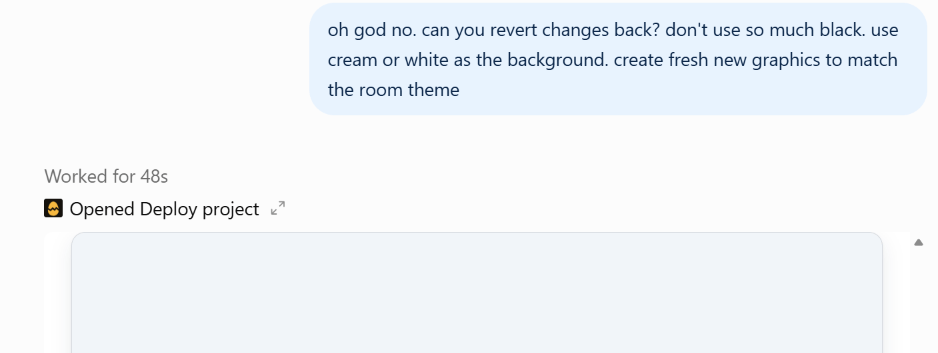





We were on Version 44 of artwork that should have been straightforward. This conversation would go on into the wee hours of the morning. And left me wondering if I would have been better off designing my own artwork in Canva or Photoshop, because no amount of accurate prompting would give me the control that a mouse, predictable outcome and intention does.
You see, the very left-brained approach of LLMs towards artistic or creative, big picture work is it tries to abide by instructions (your prompts) to the T. In that rigid attempt, every iteration messes up another part of the design while fixing your area of concern. The focus gets narrower and narrower with each prompt such that the dream you started with has turned into a contorted nightmare. Don’t curse AI – it’s just staying true to its nature. It can counterfeit the appearance of creative execution while remaining blind to the true underlying intent.
When you ask this mathematical engine to deliver an outcome that relies on subjective human context, whether that’s navigating a chaotic, untemplated physical environment or making an instinctive creative leap, it’s bound to hit a barrier. In getting AI to replicate the human right-brain mechanics outlined in this essay, the human ends up prompting AI so extensively that it begins to resemble computer code written in human language instead of, say, C++. It’s so specific and precise with no room for ambiguity that it makes you wonder who is assisting whom, and whose intelligence is needed here, because AI now demands that we do much of the translation from intent to outcome ourselves.
AI and “Right Brain” Art
The statement that AI will likely never write a truly soul-stirring novel or invent a completely brand-new artistic concept out of thin air is rooted in the mathematical and architectural limits of how modern AI actually works. While AI can write flawless grammar, mimic Shakespeare, or generate beautiful images, it hits a fundamental wall when it comes to true artistic genius. This comes down to three core reasons:
1. Regression to the Average
AI models are trained to predict the most statistically probable next word (or token) based on everything humanity has already written. By definition, high art and creative genius are statistically improbable. True artistic breakthroughs happen when an artist deliberately breaks the rules, introduces a shocking paradigm shift, or uses language in a way that has never been done before. Because AI naturally optimizes for statistical probability, its creative output inevitably drifts toward the “average” of human output – resulting in clichéd plots, predictable metaphors, and synonyms rather than true innovation.
2. The Absence of Lived Experience
A soul-stirring novel isn’t just a combination of vocabulary; it is a digital reflection of the messy, physical, emotional reality of being alive. When an AI writes about grief, it is just remixing text patterns associated with the word “grief.” It cannot draw upon a reservoir of genuine emotion to create something deeply original because it lacks the foundational context of a conscious life.
3. The Interpolation vs. Extrapolation Dynamic
In computer science, there is a strict difference between interpolation (filling in the gaps within known data) and extrapolation (venturing into completely uncharted territory). AI is a master of interpolation: if you give it a data pool of 1,000 detective novels, it can perfectly map out the average structure and generate a 1,001st detective novel that fits the pattern seamlessly.
Art requires extrapolation: To create a completely brand-new artistic concept – like inventing Cubism in art, or creating an entirely new literary genre – you have to step completely outside the existing data pool. Because an AI cannot think outside the boundaries of the mathematical weights created by its training data, it cannot “leap” into a brand-new artistic dimension out of thin air.
This carries over to Business as well.
If you ask an AI to design a strategy for a car company, it will analyze massive data sets, predict market shifts, and tell you how to maximize margins on your existing vehicles. The AI could never look at the horse-and-buggy market in 1900 and invent the concept of the mass-market assembly line automobile, nor could it look at a luxury sedan market and decide to risk everything on building a global electric charging network (Tesla). True innovation requires extrapolation. Because an AI has never felt a human emotion, it cannot inherently judge whether a strategic pivot will alienate a loyal customer base or inspire a workforce. Humans are needed to read between the lines of market data to understand the underlying human behavior driving the numbers.
Left Brain Work Masquerading as Right Brain Thinking
A lot of AI skeptics say wake me up when AI cures cancer. They challenge AI’s ability, and very much akin to what we’ve been exploring ourselves here, to prove itself at invention and discovery. Given all that we’ve written so far about AI not being the best at “right brain work” – creating something from nothing – seems contradicting with asserting AI excels at drug discovery. The resolution is simple – drug discovery is scientific, logical and every bit mathematical. It’s simply left brain work masquerading as right brained, and which is why we’d be doing ourselves a disservice by leaving AI out of cancer research.
You see, science is governed by rigid, objective laws of physics, chemistry, and math. To discover a new material or a new drug, you don’t need artistic “soul” or intuition; you need to map an astronomical number of mathematical permutations to see what fits. This is exemplified by the Protein Folding Breakthrough. Before AI, human scientists spent decades trying to map the 3D structures of proteins. Google’s AlphaFold (an AI) solved 200 million protein structures in a fraction of the time. The AI didn’t invent biology; it simply saw geometric patterns in molecular physics that human eyes were too slow to notice.
The AI’s ability to strictly follow patterns, cross-reference data, and optimize within the rigid laws of physics or mathematics is what makes it an incredibly powerful (and potentially dangerous) tool for discovery.
So, what is our stance with all of this? It’s, in essence, that AI can out-compute our left brain, but its left-brain mechanics will limit it from trying to replace the human right brain.
And this is not simply a limitation of today’s AI that more parameters, more training data, or greater computational power will inevitably overcome. The fundamental challenge is that creative intent cannot always be reduced to a set of explicit instructions or mathematical objectives. Unlike structured problems with clearly defined goals and success criteria, creative work often requires interpreting ambiguous intent, weighing competing possibilities, recognizing what makes one option more compelling than another, and making strategic choices when there is no objectively correct answer. AI can become increasingly sophisticated at modeling context, generating alternatives, and optimizing outputs against a given objective. But its mathematical mechanisms still require some basis for evaluating those possibilities, whether specified by humans or learned from data. The difficulty is not just generating an output; it is consistently and reliably arriving at the right creative direction and translating it into an outcome that achieves the intended purpose. More computational power can expand what AI can do, but it does not automatically close the gap of how that direction is chosen in the first place.
Is AI all Hype?
Does this mean AI is just hype then? No, far from it. AI already delivers genuine value as we saw earlier by performing tasks that would otherwise demand substantial human time, effort, or expertise, or by stepping in precisely where physical limits leave humans unable to operate. Its limitations in replicating human ingenuity do not erase those achievements. But neither do its achievements prove that it can replicate every dimension of human intelligence or exceed it altogether into a state of superintelligence.
The confusion starts when success in one domain is treated as evidence of general intelligence. We mistake a convincing output for an actual understanding of context in which that output must succeed, or when improvements in computational performance are taken as proof that every limitation is merely a temporary engineering problem waiting to be solved. These things just aren’t the same. AI can be remarkably powerful within its limits without being limitless. Recognizing this distinction is not a failure to embrace AI and its promise; in fact, quite the contrary. It is a call for clarity against confusing what the technology demonstrably does with what we assume it must eventually become, so that we can harness its most viable potential.
This has a direct implication for how the human-machine relationship must resolve. Drawing an analogy from Iain McGilchrist’s The Master and His Emissary, AI is not a replacement for human intellect, but its ultimate emissary. In this framework, the machine takes over the well-defined, logical, optimization tasks it was built for. But an emissary cannot be the master. The human mind must remain the sovereign director of the enterprise, because only a human can hold true intentionality, read ambiguous human contexts, and bear the legal and moral responsibility of a final decision.
Failing to respect this boundary creates three major vectors of risk:
1. The Operational Risk: Speed and Complexity Trap
When businesses attempt to force “left-brain” AI into highly autonomous workflows without a human “right brain” gatekeeper, they create a dangerous speed trap. Because AI operates at machine speed, any minor computational fault, data distortion, or contextual misunderstanding will propagate through connected enterprise pipelines in milliseconds, far outrunning a human supervisor’s ability to notice and pull the plug.
2. The Strategic Risk: The Fallacy of Autonomous Tools
When enterprises delegate long-term planning, multi-step problem solving, or architectural decisions entirely to agentic AI workflows, they run headfirst into a mathematical “memory” wall. Complex, multi-day autonomous iterations naturally degrade due to context window exhaustion or data drift across external memory stores. The model inevitably loses the master “intent” or hallucinates instructions, leading to systemic code or process failures.
3. The Systemic Risk: Common Mode Failure
Because building massive foundation models is an incredibly centralized game, the global economy is hooking thousands of independent, “unrelated” workflows into the exact same handful of AI brains via APIs. If a core model suffers from a deeply hidden logic flaw or a specific hallucination trigger, that single vulnerability instantly manifests across thousands of downstream corporate platforms simultaneously. A standard software bug causes a single application to crash, whereas an AI engine fault can cause a parallel, market-wide cascade failure. This necessitates far more humans in the loop than AI enthusiasts claim.
This reality defines the true promise of AI. When we stop forcing AI to act like a right-brain visionary and start deploying it as a tireless left-brain engine, the partnership clicks. The human defines what matters, reads ambiguous reality, and imagines futures no dataset could ever predict; the AI navigates trillions of variables, uncovers hidden patterns, and executes at a scale the human brain could never sustain on its own. That symbiosis – human Master, machine Emissary – is where the future stabilizes and where humanity reaches beyond its biological limits.
With a little bit of imagination, originality and ambition, we can create a future where the true promise of AI:
- is not automated velocity, but rather differentiated user experiences for strategic advantage. Anyone can plug in an API to make an existing workflow faster; the real winners will combine AI’s pattern-finding scale with human taste and empathy to build deeply intuitive products that were previously impossible to deliver.
- is not obliterating headcount for profit, but rather amplifying human capability through tech augmentation. Cutting humans out of the loop leads to commoditized mediocrity, whereas pairing a human Master with an AI Emissary expands what a small team can discover, simulate, and build by orders of magnitude.
- is not unbridled productivity, but rather eliminating unnecessary work. The goal isn’t to flood the world with ten times more auto-generated noise, but to free human minds from the mechanical drudgery of wrangling with sub-optimal tools to get the job done so we can focus on breakthroughs, creativity, and problems that truly matter.
Here is the core truth we want you to leave with: AI is the most consequential technology of our times. Navigating it requires us to make organizational, product, and strategic decisions from a position of clarity, deep understanding, and vision rather than a place of fear and short-sightedness.
*Sources:
Gainotti (2012), “Unconscious Processing of Emotions and the Right Hemisphere.”
Brederoo et al. (2017), “Hemispheric Specialization for Global and Local Processing: A Direct Comparison of Linguistic and Non-Linguistic Stimuli.”
Mihov, Denzler & Förster (2010), “Hemispheric Specialization and Creative Thinking: A Meta-Analytic Review of Lateralization of Creativity.”
Jung-Beeman (2011), “Intuition, Insight, and the Right Hemisphere: Emergence of Higher Sociocognitive Functions.”


Leave a Reply